

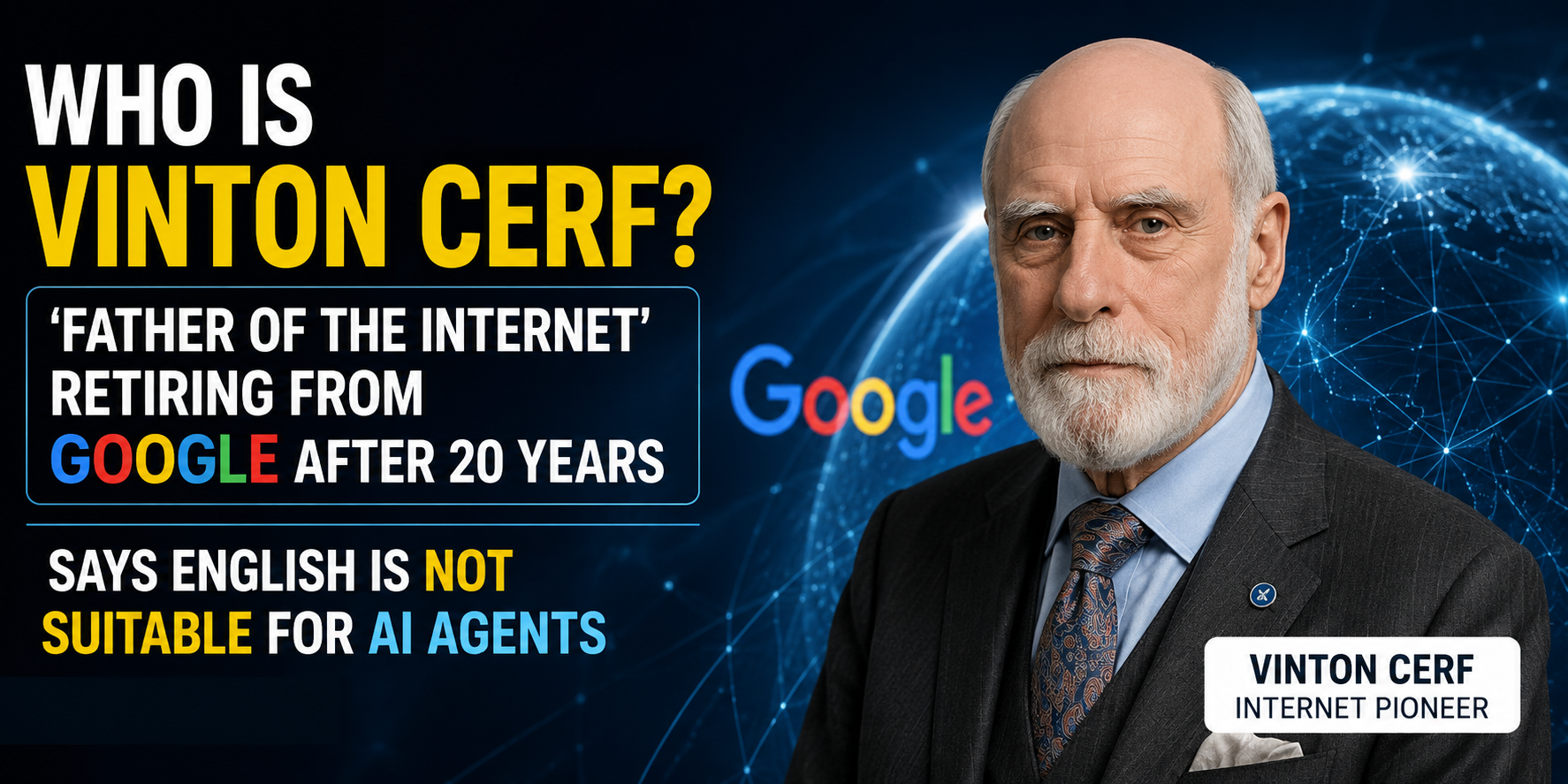
Vinton Cerf, widely known as the “Father of the Internet,” is set to retire from Google after serving the company for two decades. The announcement came during the Open Frontier conference hosted by the Laude Institute, where UC Berkeley professor Dave Patterson shared the news with the audience. Patterson praised Cerf’s remarkable career, prompting applause from attendees. Cerf joined Google in 2005 as Vice President and Chief Internet Evangelist, where he played a key role in promoting internet innovation and shaping discussions on future technologies.
Also Read : Pakistan: 14 Prisoners Evade Custody After Throwing Chilli Powder at Escorting Police
Retirement Announcement Sparks Discussion on AI’s Future
The 83-year-old computer scientist earned the title “Father of the Internet” for co-developing the TCP/IP networking protocols with fellow researcher Robert Kahn in the 1970s. These protocols established the foundation of the modern internet by enabling different computer networks to communicate with one another. Today, TCP/IP remains the backbone of global internet connectivity. Cerf’s work has had a lasting impact on digital communication and online services used around the world.
Throughout his career, Cerf received several prestigious awards for his contributions to computing and technology. In 2004, he was honoured with the ACM Turing Award, one of the highest recognitions in computer science. A year later, former US President George W. Bush presented him with the Presidential Medal of Freedom, the highest civilian honour in the United States. He has also received numerous honorary degrees from institutions across the world.
Also Read : Monsoon Havoc: Flood Hits Manali-Leh Highway, Cloudbursts Disrupt Doda
Internet Architect Explains Need for Precise AI Communication
During the conference, Cerf also shared his thoughts on the future of artificial intelligence and how AI agents will communicate with one another. He argued that English may not be the most suitable language for communication between AI systems because it contains too much ambiguity. According to Cerf, AI agents require precise and unambiguous communication to ensure they correctly understand tasks and agreements without confusion.
To explain his viewpoint, Cerf referred to the children’s game “Chinese whispers” (also known as the telephone game), where a message changes as it passes from one person to another. He said a similar problem could arise if AI agents relied solely on natural languages such as English. Cerf believes future AI systems will benefit from a more structured and precise communication method that minimizes misunderstandings and improves coordination between intelligent machines.
Also Read : Pakistan: 14 Prisoners Evade Custody After Throwing Chilli Powder at Escorting Police