

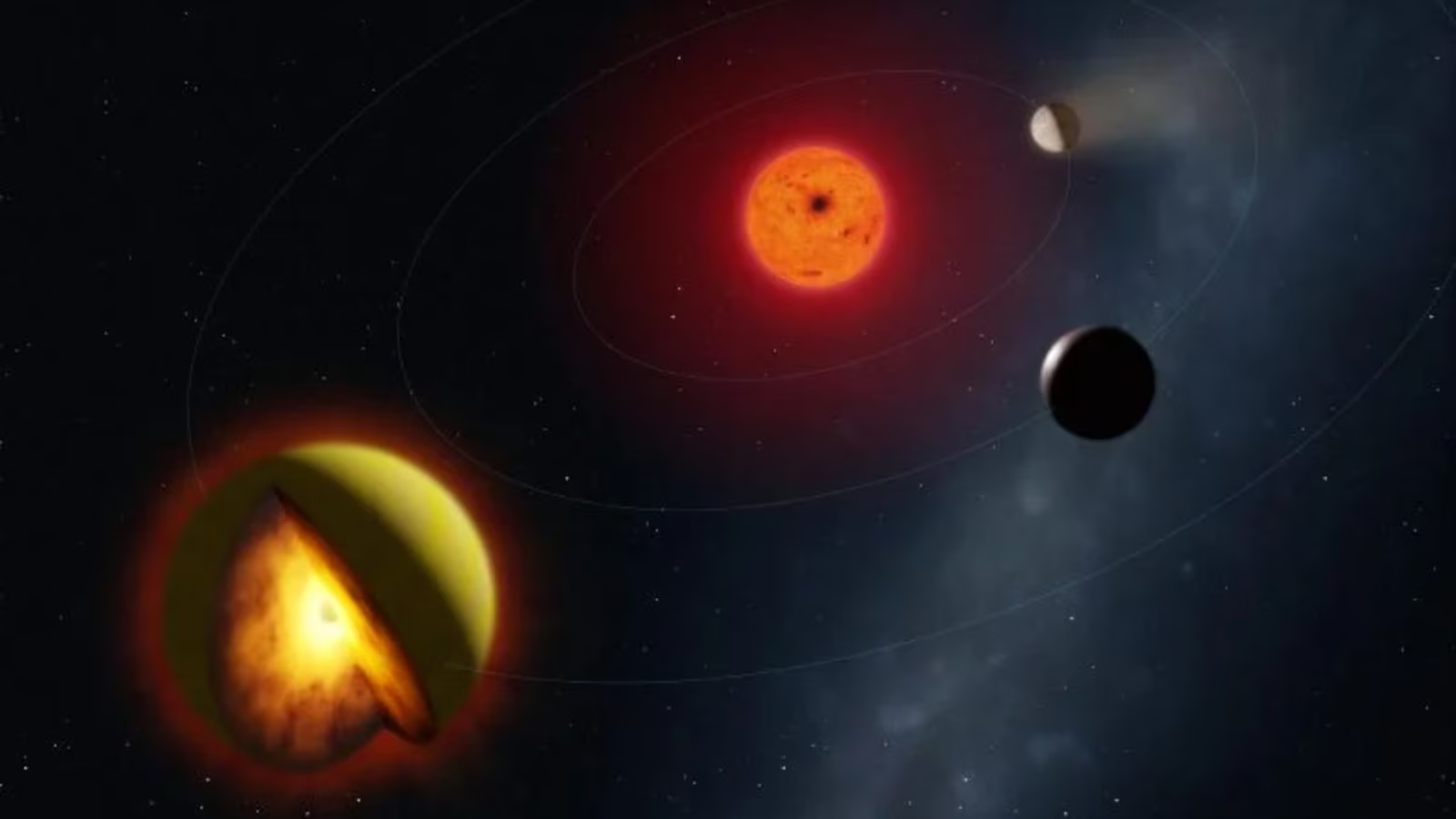
Scientists have identified an entirely new category of “liquid planet” that exists in a permanent molten state. Traditionally, astronomers classified small exoplanets as either rocky “gas dwarfs” with hydrogen atmospheres or “water worlds” covered in deep oceans and ice. This new discovery, published in Nature Astronomy, introduces a third class—planets that exist as global oceans of magma.
The primary example of this category is L 98-59 d, located about 35 light-years from Earth. Scientists detected the planet using the James Webb Space Telescope, the most powerful telescope ever launched into space.
Harrison Nicholls from the University of Oxford described the planet as being in a “mushy, molten state,” similar to molasses. Its mantle consists of molten silicate, and it likely contains a molten core. The planet’s surface temperature reaches an extreme 1,900°C (3,500°F). Gravitational forces from nearby planets generate massive waves across its global magma ocean.
Scientists estimate that the rocky planet has a radius about 1.63 times larger and a mass about 1.64 times greater than Earth’s. It orbits a small red star and is surrounded by a thick atmosphere rich in hydrogen sulfide, which produces a strong rotten egg-like smell.
Also Read: US Jets Hit Military Facilities Close to Iran’s Chabahar Trade Zone: Report
Scientists Rethink Planet Categories as Molten Worlds Redefine Space
Nicholls said this discovery challenges the current classification of small planets, suggesting that existing categories may be too simplistic. While the planet cannot support life, it highlights the vast diversity of worlds beyond our solar system and raises questions about what other types of planets scientists may discover in the future.
He also noted that although the idea of life existing in lava sounds fascinating, it is highly unlikely that the planet is habitable. Instead, its extreme and alien nature makes it scientifically intriguing.
Unlike Earth, which cooled from its molten state billions of years ago, L 98-59 d remains in a molten condition due to a runaway greenhouse effect. Its dense atmosphere traps heat, preventing it from escaping, while tidal heating from neighboring planets generates additional internal heat.
Data from the James Webb Space Telescope suggests that many planets previously considered potential “water worlds” may actually be uninhabitable molten planets. These worlds act as time capsules of Earth’s early magma phase and help scientists identify extreme, “hellish” planets that could otherwise be mistaken for habitable ones.
Also Read: Inside IIT Madras: Unlocking the secrets of the human brain