

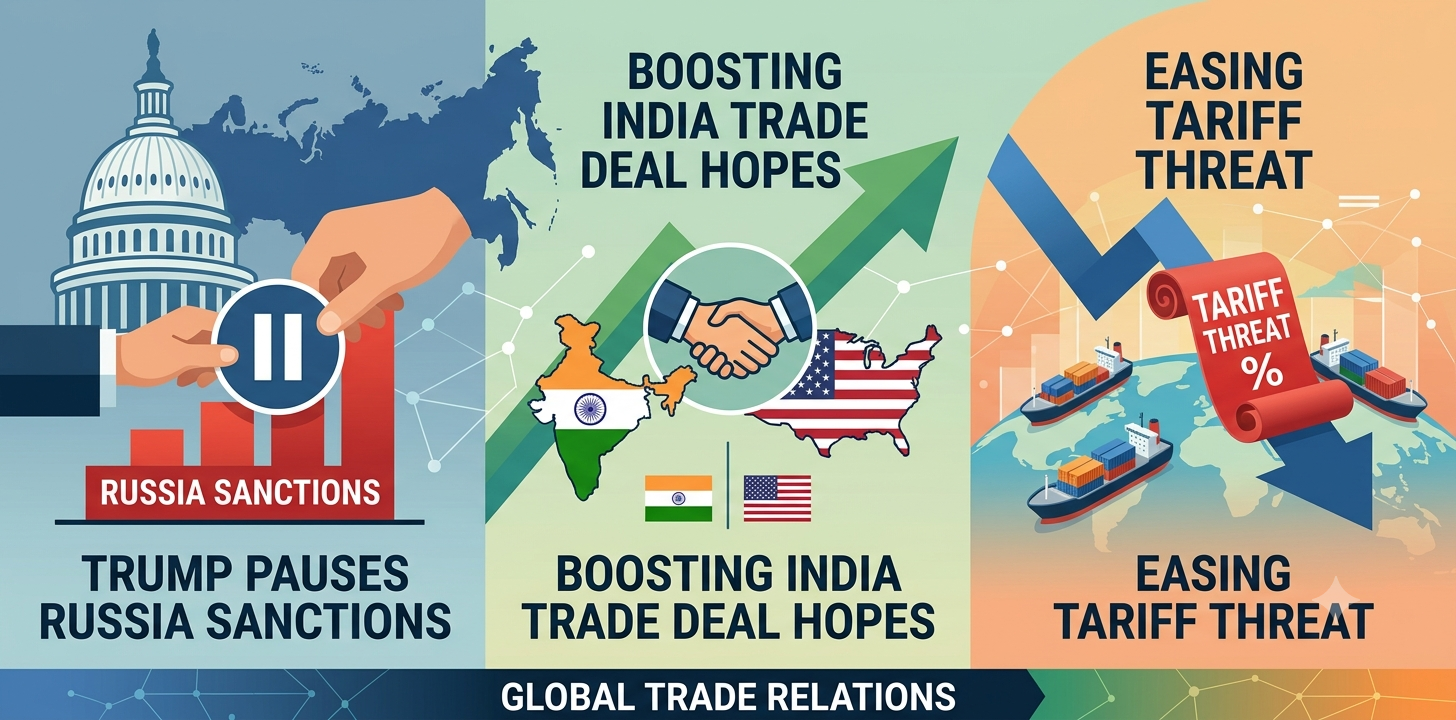
President Donald Trump has temporarily eased the threat of heavy US tariffs on India by waiving sanctions provisions under the Lindsey O. Graham Sanctioning Russia and Iran Act of 2026. The law authorised Trump to impose tariffs of up to 100% on major buyers of Russian energy, including India and China. The decision comes as global crude oil prices rise above $110 per barrel and the US approaches its midterm elections. Washington has prioritised stabilising fuel prices while managing its broader geopolitical and trade interests. The move could give India some relief from the pressure linked to its Russian oil purchases.
Also Read : India–UK Relations: Building a Shared Future
US-Russia Diesel Deal Influences Sanctions Policy
Trump’s decision follows efforts to increase fuel supplies and control rising energy costs. The US president said Russia had agreed to supply additional diesel to international markets, with further shipments expected in the coming months. He also urged Ukraine to avoid targeting Russian oil refineries under a proposed ceasefire framework. Ajay Srivastava, founder of the Global Trade Research Initiative, said the waiver highlights uncertainty in US trade policy. He argued that Washington has stepped back from potential penalties after reaching an arrangement involving Russian diesel supplies.
India has also taken steps on trade concerns raised by the United States and other major economies. The government previously banned imports of goods produced using forced labour following the first US Section 301 investigation. India also joined other G20 countries in supporting action against structural overcapacity in sectors such as automobiles, electric vehicles, batteries, chemicals, semiconductors and solar panels. These developments could help both countries narrow their differences during trade negotiations. However, the latest waiver does not guarantee a final agreement or eliminate the possibility of future tariff pressure.
Also Read : Gold Prices May Fall This Diwali as Diamonds Gain Popularity in India
Rising Fuel Prices Put Pressure on Inflation
High energy prices continue to challenge policymakers in both the United States and India. According to the figures cited in the report, US diesel prices averaged $6.18 per gallon on October 12, compared with $3.48 at the beginning of the year. US consumer prices rose 0.6% in September, taking annual inflation to 3.7%. In India, retail inflation increased to 5.54% in September from 4.83% in August. Food inflation also climbed to 7.74%, driven by rising prices of items such as onions, ginger, garlic and lemons.
Trump’s decision offers India temporary relief from the immediate threat of steep tariffs linked to Russian energy imports. However, changing US policy and wider geopolitical tensions continue to create uncertainty for Indian exporters and policymakers. New Delhi must balance affordable energy supplies with its efforts to strengthen trade relations with Washington. A broader trade agreement could provide greater certainty for businesses and support bilateral economic cooperation. For now, the sanctions waiver has improved the outlook for negotiations, but both countries must resolve their remaining differences before a deal becomes a reality.
Also Read : India–UK Relations: Building a Shared Future