

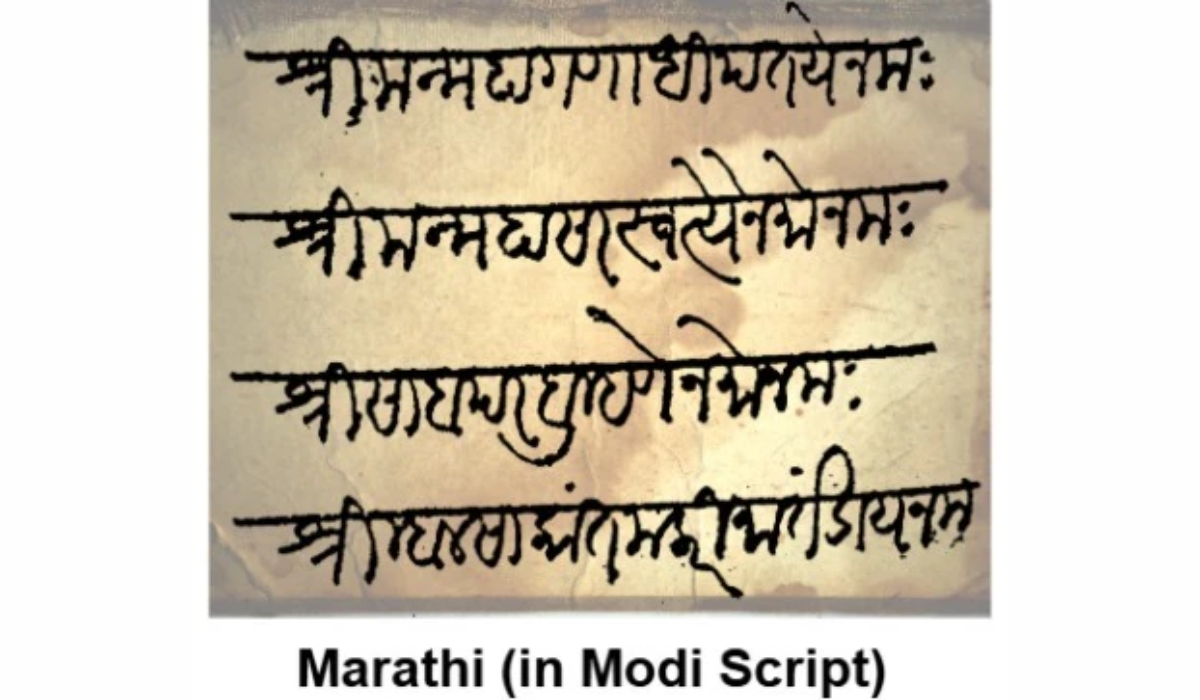
In a significant step towards blending India’s historical heritage with cutting-edge AI technology, the Indian Institute of Technology Roorkee (IIT Roorkee) has jointly developed the world’s first AI-based system to transliterate the ancient Modi script into Devanagari. Named MoScNet, this model uses Vision-Language Model (VLM) architecture to aid in the preservation of medieval manuscripts and supports large-scale digitization efforts under national programs like Digital India and Bhashini.
The project, titled Historic Scripts to Modern Vision, introduces MoDeTrans, the first dataset of its kind, featuring over 2,000 images of real Modi script manuscripts spanning three historical eras: Shivakalin, Peshwekalin, and Anglakalin, along with expert-verified Devanagari transliterations. The AI model MoScNet, led by Prof. Sparsh Mittal of IIT Roorkee, significantly outperforms existing OCR models and offers a scalable, lightweight solution ideal for deployment in low-resource environments.
Students from Pune Join Hands with IIT Roorkee to Preserve India’s Script Heritage Using AI
The research team also included contributions from students, Harshal and Tanvi, who pursued their studies at COEP Technological University (formerly College of Engineering, Pune) and Onkar, an alumnus of Vishwakarma Institute of Information Technology, Pune. Their collaborative efforts played a key role in developing and refining the transliteration framework.
Prof. Kamal Kishore Pant, Director, IIT Roorkee, said, “This work shows how we can harness the power of AI not just for automation, but to revive our cultural heritage, empower academic research, and drive nation-building. It captures the true spirit of Viksit Bharat, preserving India’s timeless wisdom and making it accessible to the world through technology.”
With over 40 million documents in the ancient Modi script across India—ranging from land records to Ayurveda texts—there has been a critical need for efficient digitization and preservation. Addressing this, IIT Roorkee has co-developed the world’s first AI model, MoScNet, to transliterate Modi script into Devanagari using Vision-Language Model (VLM) architecture. This effort bridges a crucial gap in academic and archival research, especially given the scarcity of Modi script experts and the deteriorating state of manuscripts.
Led by Prof. Sparsh Mittal, the project aims to democratize access to India’s ancient knowledge using open-source, ethically trained AI tools. MoScNet supports national missions like Digital India, Bhashini, and BharatGPT, while aligning with the UN Sustainable Development Goal 11.4. The team has open-sourced both the MoDeTrans dataset and MoScNet model on Hugging Face, promoting global use and collaborative research in historical script digitization.