

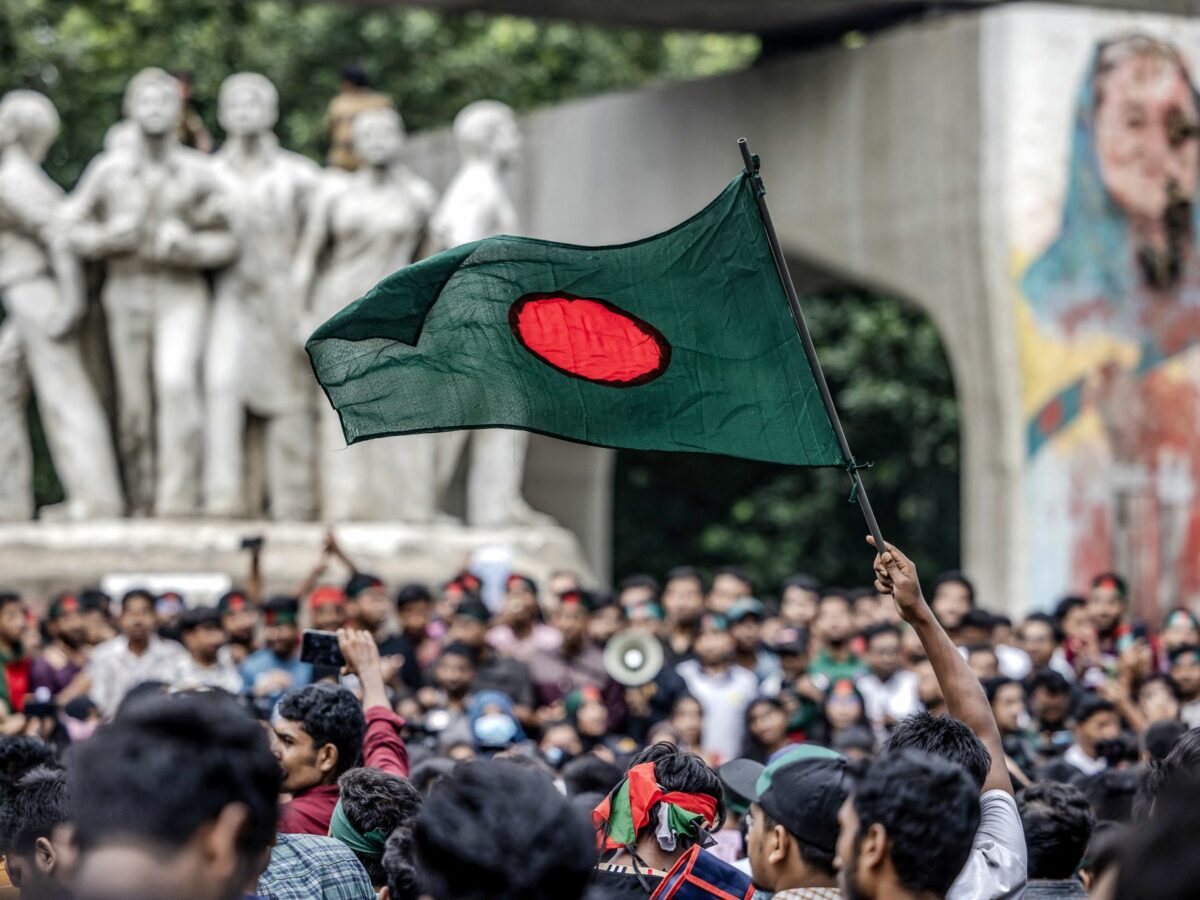
Bangladesh youth turning against India has become one of the most striking political shifts following the fall of Sheikh Hasina in 2024. From university campuses to social media, young Bangladeshis are questioning India’s role in their country’s democratic erosion, foreign policy and regional power dynamics. What was once seen as a close partnership is now increasingly viewed by many in the younger generation as political interference rather than friendship.
Bangladesh’s Youth Turns Inward — and Against India
The walls of Dhaka University are speaking again. Angry, witty and sometimes poetic graffiti now fills corridors and courtyards, echoing the Gen Z–led uprising of July 2024 that ended Sheikh Hasina’s 15-year rule. Once celebrated as a pro-democracy leader, Hasina had come to be seen by many as increasingly authoritarian. After stepping down, she fled to India.
Across campus, students cluster in debate. Nearby, red lanterns swing over a modest Chinese New Year celebration — a subtle reminder that Bangladesh has become a site of strategic competition between Beijing and Delhi. For many young voters, the national election scheduled for 12 February will be their first genuine experience of democracy.
Nobel Peace Prize winner Muhammad Yunus assumed leadership days after Hasina’s fall. Meanwhile, India refused to extradite the former prime minister, who now lives in Delhi despite having received a death sentence in absentia for her role in the 2024 security crackdown. The United Nations estimates that around 1,400 people — mostly killed by state forces — died during that period.
Also Read: 30-hour gridlock jam cripples Mumbai–Pune Expressway
From Democratic Grievance to Anti-India Anger
Hasina’s Awami League, which once commanded roughly 30% of the vote, has been barred from contesting the election. Analysts say the Bangladesh Nationalist Party (BNP) is now moving to fill the political vacuum, while Jamaat-e-Islami has allied itself with a party born from the student movement.
Yet the slogans filling campuses go beyond domestic politics. Many directly target India.
“Dhaka, not Delhi” now appears on walls and even stitched onto saris. Among young Bangladeshis, the word “hegemony” has become shorthand for India’s perceived dominance. Students argue that India repeatedly interfered in Bangladesh’s politics, especially after the disputed elections of 2014, 2018 and 2024.
Many believe Delhi enabled Hasina’s authoritarianism by endorsing flawed elections and maintaining unconditional support. Over time, that perception fused with older grievances — border killings, unresolved water-sharing disputes, trade barriers and inflammatory rhetoric from Indian politicians and television debates. Together, they fuelled a growing belief that India treats Bangladesh as a subordinate rather than an equal partner.
A Relationship at Its Lowest Point — But Not Broken
India has tried to expand its outreach. Foreign Minister S Jaishankar recently visited Dhaka for the funeral of former prime minister Khaleda Zia and met BNP leader Tarique Rahman, now a leading electoral contender. Indian officials have also quietly engaged Islamist parties, including Jamaat-e-Islami.
These moves, however, have done little to reverse the broader collapse in goodwill. Analysts describe the current moment as the lowest point in India–Bangladesh relations in decades. What once functioned as a comprehensive partnership — covering security, trade, transit and cultural exchange — has largely stalled.
Bangladeshi officials stress that geography and shared history still bind the two countries. They share 54 rivers, a long and porous border, and deep cultural ties. Yet public sentiment has clearly hardened. Many young Bangladeshis blame India for backing Hasina until the very end and for offering her refuge after the 2024 violence.
Despite this anger, hostility toward India rarely extends to Indian people. Activists emphasise that their dispute is with the Indian state, not society. Analysts agree that the rupture is serious but reversible. A reset will require India to engage whoever governs in Dhaka — and to treat Bangladesh as a sovereign equal rather than a strategic asset.
Also Read: Border 2 Crosses 400 Crore Bigger Hit Than Uri and Gadar 2
[…] Also Read: Bangladesh youth turning against India […]