

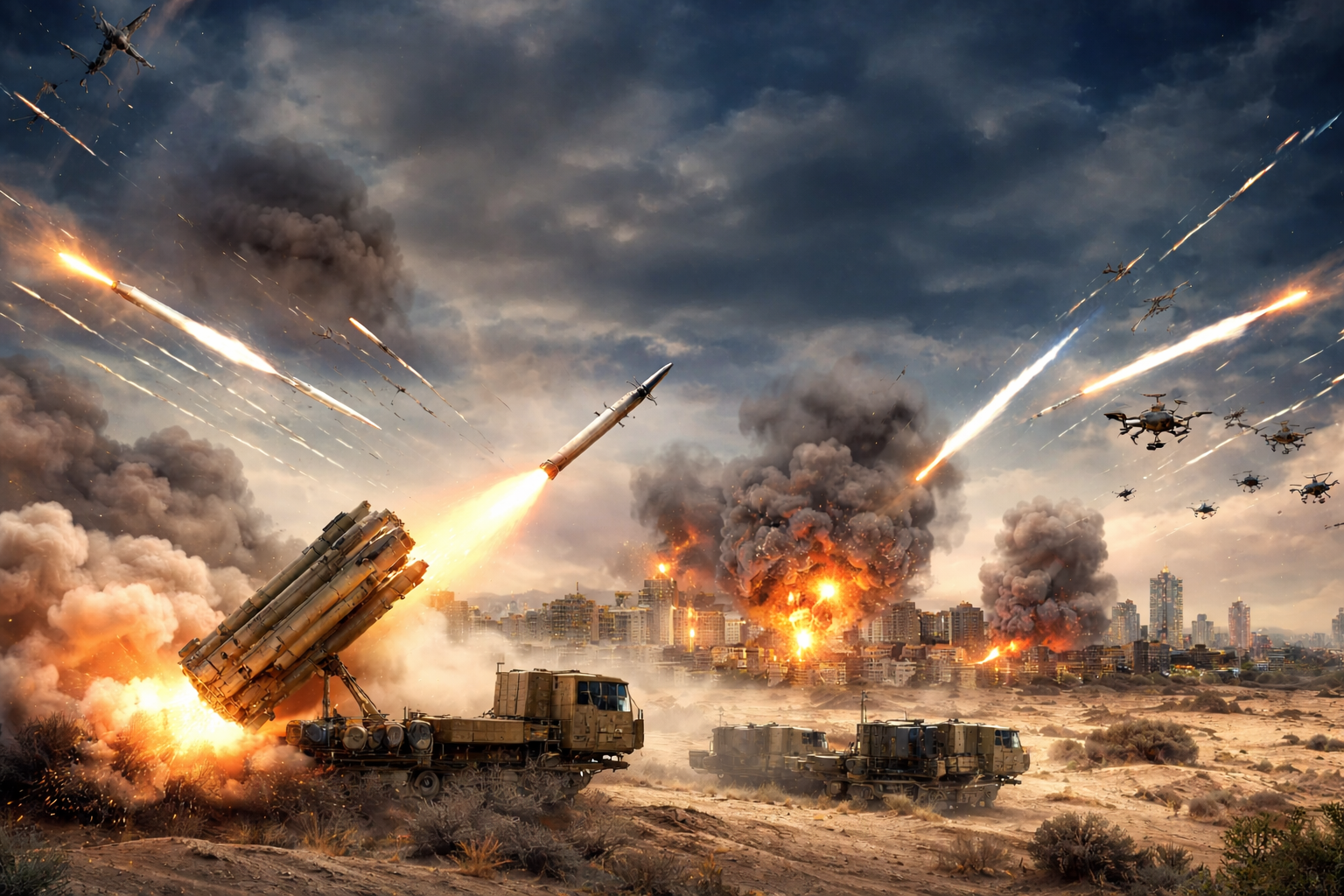
The Gulf missile defence failure has triggered serious debate across global defence circles after advanced U.S. systems failed to fully stop a large-scale aerial assault. Gulf countries had invested billions in high-end platforms like THAAD and Patriot PAC-3 to counter threats from Iran. When the attack came, Iran launched a mix of ballistic missiles and drone swarms, targeting multiple locations at once. Defence systems intercepted several threats, but many still broke through the shield. The scale and coordination of the assault exposed clear operational limits. Analysts now question whether current missile defence systems can handle modern warfare tactics. The incident has also forced Gulf nations to rethink their security strategies. The Gulf missile defence failure now stands as a major turning point in regional defence planning.
Mass attacks stretched defence systems beyond limits
Iran executed a coordinated assault using hundreds of missiles and drones, which created immense pressure on defence systems. The Gulf missile defence failure became visible as interception systems struggled to respond quickly to multiple incoming threats. THAAD systems targeted high-altitude ballistic missiles, but they could not effectively engage low-flying drones. This forced other systems to take on additional workload, increasing overall strain. Operators had to make rapid decisions under intense pressure, which affected response efficiency. The attack demonstrated how modern warfare uses volume and speed to challenge even the most advanced systems.
The defenders tried to intercept as many threats as possible, but the attack’s scale made complete protection impossible. Systems like Patriot handled some targets, yet they could not maintain consistent interception rates under saturation. The combination of altitude variation and attack timing complicated tracking and targeting. Each wave of incoming threats forced systems to operate at maximum capacity. As a result, gaps appeared in the defence network. These gaps allowed some missiles and drones to reach their targets. The Gulf missile defence failure clearly showed how coordinated mass attacks can overwhelm layered defence systems.
Also Read: Mumbai Airport T1 Fire Contained
Cost imbalance exposed a major weakness
The Gulf missile defence failure also highlighted the growing problem of cost imbalance in modern warfare. Defence systems rely on expensive interceptor missiles, while attackers use cheaper drones and basic missiles. This creates a situation where defenders spend far more resources to stop relatively low-cost threats. Iran leveraged this imbalance by launching large numbers of inexpensive weapons. Each interception required a costly response, quickly increasing the financial burden on defenders. Over time, this strategy reduces the sustainability of defence operations.
Military experts have already observed similar patterns in conflicts like the Russia-Ukraine War. In such conflicts, low-cost drones have proven highly effective against expensive defence systems. The same principle applied in this case, where volume outweighed technological advantage. Defenders risk running out of interceptors faster than attackers run out of weapons. This imbalance forces countries to rethink their defence spending priorities. The Gulf missile defence failure has now made this issue impossible to ignore. It signals a shift toward more cost-efficient warfare strategies.
Also Read: MHT CET PCB Admit Card 2026 Released Exams Begin April 21
Regional powers rethink defence and diplomacy
The Gulf missile defence failure has pushed Gulf countries to reassess their long-term security strategies. Governments no longer rely solely on advanced weapons systems for protection. Instead, they are exploring a mix of military, technological, and diplomatic solutions. Countries have started improving relations with regional rivals to reduce direct threats. Engagement with global powers like China has also increased in recent years. This shift reflects a broader effort to diversify security partnerships.
At the same time, Gulf nations are investing in more flexible defence systems that can handle diverse threats. These include counter-drone technologies, electronic warfare tools, and improved radar networks. Leaders aim to build multi-layered defence strategies that can adapt to evolving threats. They also focus on intelligence-sharing and early warning systems. The Gulf missile defence failure has shown that no single system can provide complete protection. This realization is now driving a major transformation in regional defence planning.