

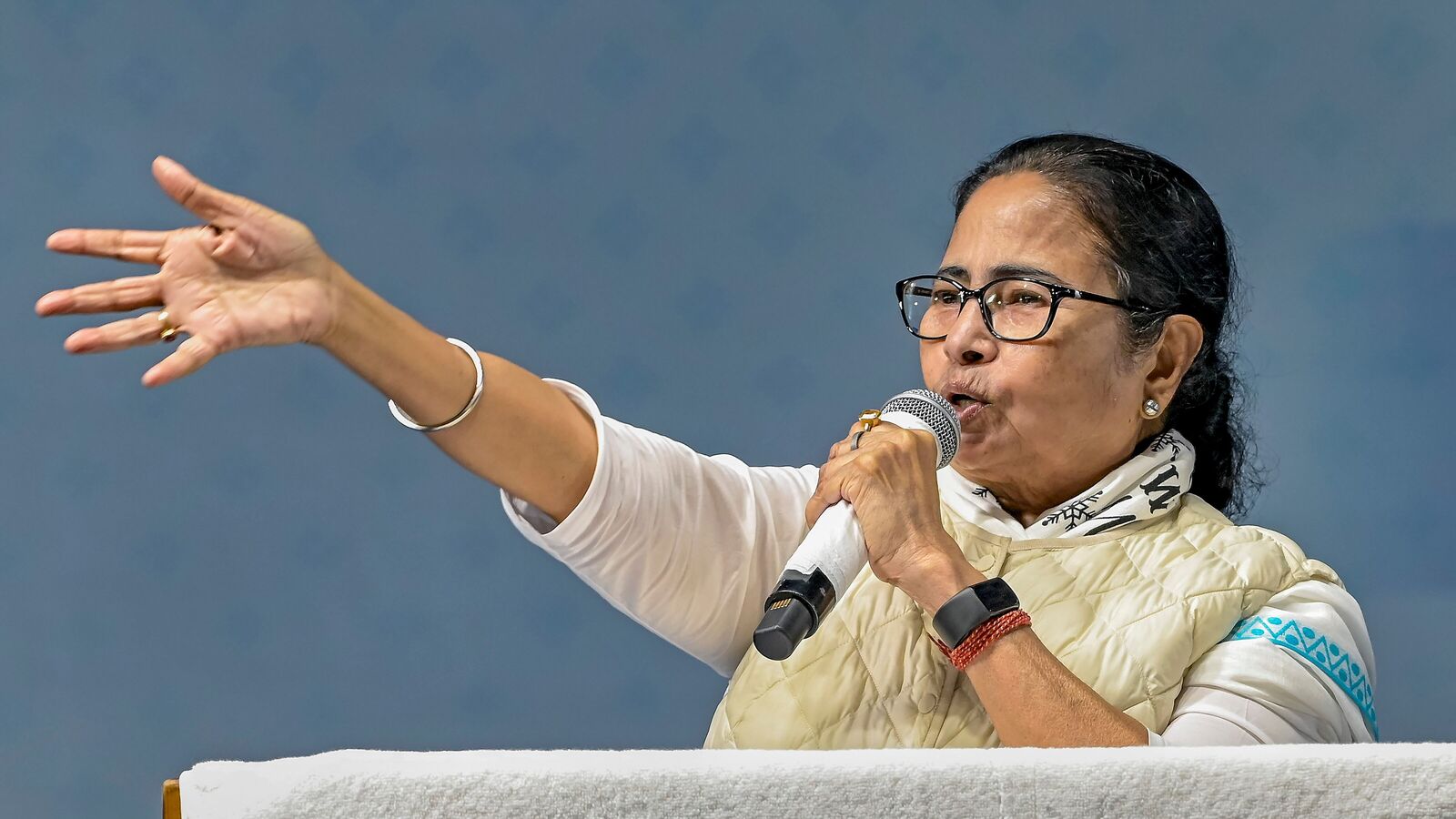
Mamata Banerjee has refused to resign as Chief Minister of West Bengal after the 2026 Assembly election results, where the Trinamool Congress lost to the Bharatiya Janata Party. Her decision has triggered a major constitutional debate, with the issue likely to reach Governor R. N. Ravi and possibly the Supreme Court for further action.
On Monday evening, Banerjee accused the Election Commission of unfair practices. She alleged that the poll body played “nasty games” and pointed to similar defeats of non-BJP alliances in states like Maharashtra, Haryana, and Bihar. She claimed that the BJP’s victory, which saw the party secure 207 out of 294 seats, resulted from an unfair and illegal campaign carried out in coordination with the Election Commission.
Banerjee strongly defended her position and stated that she had not accepted defeat. She said she would not visit Raj Bhavan or submit her resignation. By taking this stand, she projected a strong political image and signaled her intention to challenge the outcome. Her response has intensified political tensions and raised questions about the next steps in governance.
Experts have noted that India has very few precedents for such a situation. The Constitution does not clearly state that a chief minister must resign after losing an election. However, political convention requires the leader to step down when they no longer have the support of the legislative assembly. This principle ensures a smooth and peaceful transfer of power.
Once official results confirm that a ruling party has lost its majority, the chief minister is expected to resign. In this case, Banerjee’s refusal has created uncertainty and could lead to legal and constitutional intervention to resolve the situation.
Also Read: India AI Summit 2026 Highlights India’s Rising AI Ambitions and Digital Future
Mamata Banerjee Faces Constitutional Test as Crisis Deepens
If Mamata Banerjee continues to refuse resignation, the Governor has several constitutional options. One of the strongest measures includes recommending President’s Rule in West Bengal, which would suspend the state legislature and bring it under direct control of the central government. However, experts consider this an extreme step and expect authorities to use it only as a last resort.
Under Article 164(1) of the Constitution, the chief minister and the council of ministers hold office at the pleasure of the Governor. This provision allows the Governor to dismiss the government if required. In the current situation, the Governor is more likely to ask Banerjee to prove her majority on the floor of the Assembly. If she fails to demonstrate sufficient support, he can invite the leader of the majority party to form the government.
The Bharatiya Janata Party has already argued that Banerjee does not have the required numbers to continue in power. On the other hand, Banerjee has claimed that the results do not reflect the true mandate. She alleged that results in nearly 100 seats were manipulated through irregularities such as voter roll revisions and other practices. Official figures released by the Election Commission show that the Trinamool Congress secured only 80 seats, which is far below the majority mark.
Banerjee has also criticised the Election Commission, accusing it of bias and unfair conduct. She said such actions undermine democratic values and send a negative message globally. Additionally, she claimed that she faced physical assault at a counting centre, alleging that CCTV cameras were not functioning at the time.
With the Assembly’s term ending on May 7, the state now faces a tight deadline to resolve this constitutional and political crisis.
Also Read: Civilians Remain Trapped Along Ukraine Frontline