

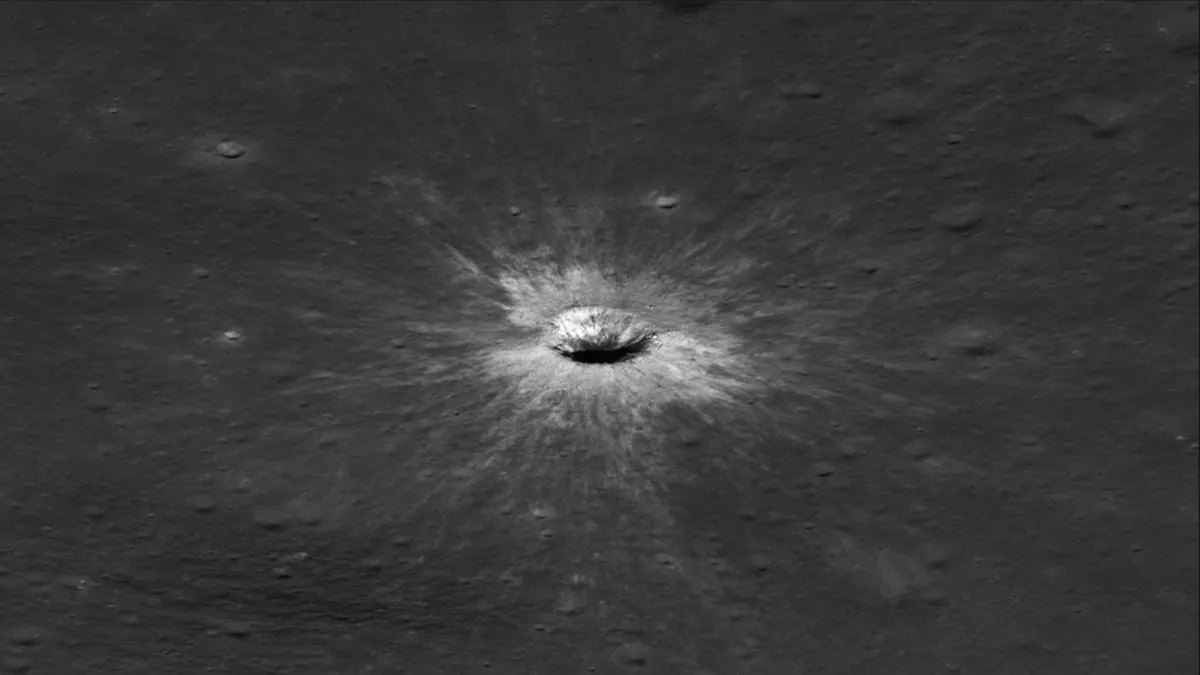
NASA’s Lunar Reconnaissance Orbiter (LRO) has detected a huge impact crater on the Moon that formed in May 2024. Scientists have named the crater McGetchin Crater after Thomas McGetchin, a former director of Houston’s Lunar and Planetary Institute. The crater measures around 728 feet (222 metres) across and reaches a depth of 141 feet (43 metres). Its size makes it the largest known recent impact crater in the solar system. Scientists say the impact initially went unnoticed by telescopes on Earth and in space.
Aso Read : Jharkhand Power Plant Shutdown Sparks Claim Over Bangladesh PM’s BRICS Absence
Impact Offers New Clues About Lunar Soil
The crater formed when a fragment of an asteroid or comet struck the Moon’s surface with enormous force. Researchers estimate that the object was roughly the size of a six-storey building before hitting the lunar surface. The impact created a crater wider than two football fields and around three times larger than the previous recent record-holder. LRO captured images of the site shortly after the impact, but scientists did not identify the crater until August 2025. Further observations later helped researchers confirm the discovery.
The powerful collision disturbed the Moon’s surface across an area stretching more than 66 miles (100 kilometres). Scientists found that the impact threw dust and rocky material farther and at a steeper angle than expected. Another study detected a cold region around the crater measuring nearly 4 miles (7 kilometres) wide. Researchers believe the area indicates that the impact loosened and rearranged the Moon’s upper soil. The findings are helping scientists better understand how impacts continuously reshape the lunar surface.
Also Read : Why Does Ganga Water Stay Fresh? Science Meets Faith
Discovery Could Help Future Moon Missions
Scientists say such a large impact is extremely rare and may occur only once in roughly 132 years. The discovery therefore gives researchers an unusual opportunity to study a recent lunar collision in detail. Observations from LRO suggest that material ejected by impacts overturns the Moon’s top layer of soil faster than previously estimated. Researchers now believe the upper two centimetres of lunar soil can be disturbed by ejecta roughly every 80,000 years. This process works much like natural gardening of the lunar surface.
The findings could also help NASA prepare for future human missions and planned lunar bases. Scientists want to determine how far rocks and other material thrown out by impacts can travel across the Moon. Understanding this risk could help engineers design stronger structures for astronauts and equipment. Researchers also say the discovery provides valuable information about the Moon’s geology and surface environment. The new crater demonstrates how even recent impacts can significantly alter the lunar landscape.
Also Read : Jharkhand Power Plant Shutdown Sparks Claim Over Bangladesh PM’s BRICS Absence